
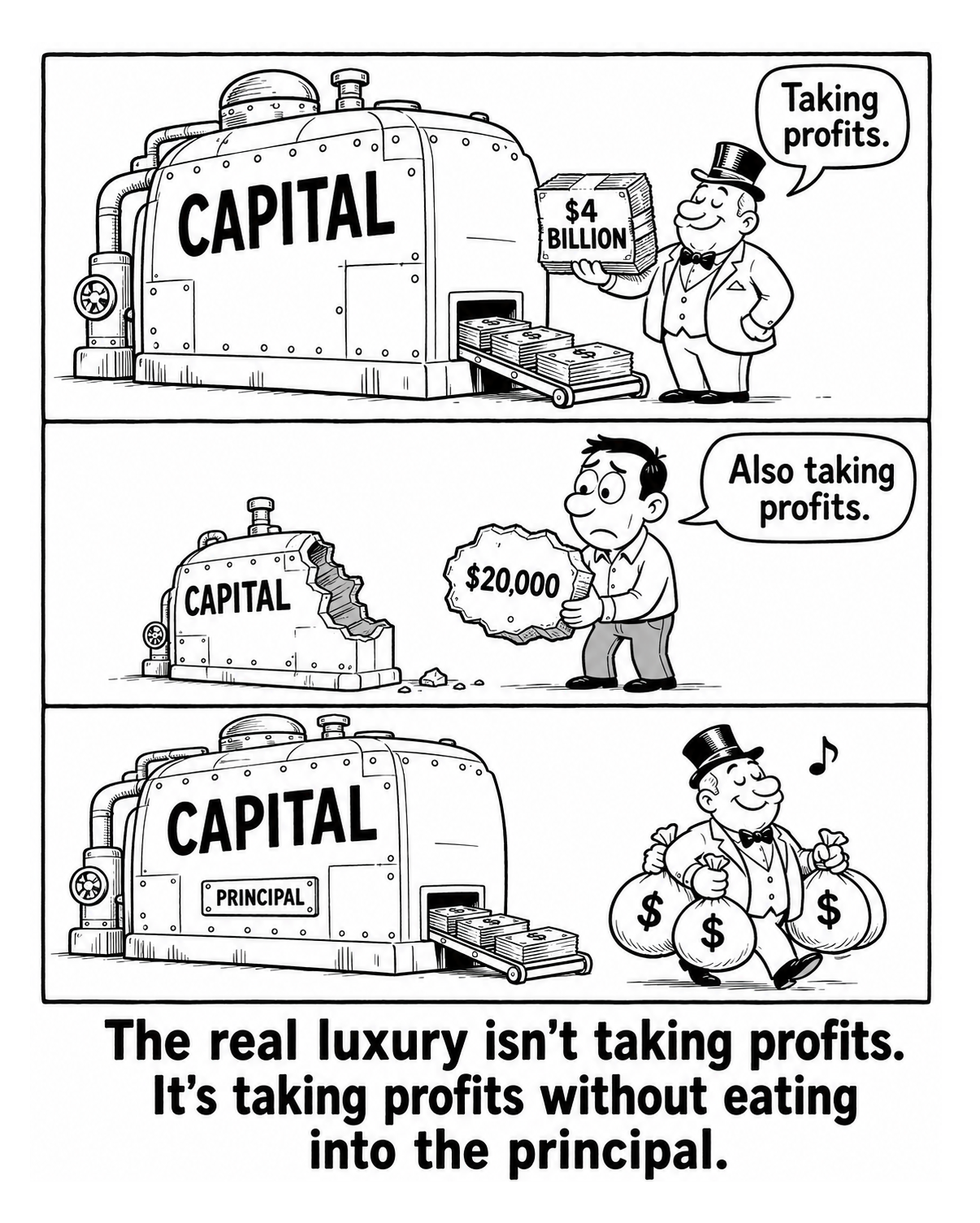
Jeff Bezos plans to sell roughly $4 billion of Amazon stock.
The headlines practically write themselves.
“Bezos is cashing out.”
Really?
Amazon is worth around $3 trillion.
Calling a $4 billion sale an exit is like calling someone homeless because they left one room in a mansion.
Scale matters.
The machine is doing exactly what it was built to do.
People imagine billionaire wealth as one gigantic bank account.
It isn’t.
It is ownership.
Public markets simply allow that ownership to be converted into cash, one small piece at a time.
Nobody bought Amazon.
Nobody emptied Amazon’s bank account.
Investors voluntarily bought a tiny slice of Bezos’ ownership.
They got the shares.
He got the cash.
Amazon didn’t even blink.
The interesting part isn’t Bezos.
The interesting part is scale.
If your investment portfolio is worth $100,000 and you sell $20,000…
…you feel it.
Your machine just became smaller.
Future gains are now generated from a smaller base.
Nothing wrong with that.
That’s simply how mathematics works.
Now imagine the machine is worth hundreds of billions.
Removing a few billion doesn’t suddenly stop it from being an enormous machine.
It keeps compounding.
It keeps growing.
It keeps producing wealth.
The harvest barely changes the field.
People keep confusing harvesting with leaving.
Those aren’t the same thing.
Selling everything is leaving.
Selling a tiny fraction of an enormous position is simply converting decades of paper wealth into real money.
Founders of successful public companies have been doing exactly that for decades.
Public markets were built for it.
Which raises an interesting question.
If you spent thirty years building one of the most valuable companies on Earth…
…what exactly would be the point if you never harvested any of it?
Maybe the story isn’t that Bezos is selling.
Maybe the story is that most people have never seen capital operating at this scale before.
The Coldcard Hack for Dummies This hacker went backward.
Advertising and ownership aren’t competitors They belong in the same branding strategy.
Disclaimer: The information provided in this article is for informational purposes only and should not be considered as financial advice. The content is based on general research and may not be accurate, reliable, or up-to-date. Before making any financial decisions, it is recommended to consult with a professional financial advisor or conduct thorough research to verify the accuracy of the information presented. The author and publisher disclaim any liability for any financial losses or damages incurred as a result of relying on the information provided in this article. Readers are encouraged to independently verify the facts and information before making any financial decisions.